Co-founder · Forecasting
PrognoseWerk: forecasting under uncertainty
A useful forecast should tell you both what to expect and how much room to leave for uncertainty.
The problem
Visitor numbers at leisure venues depend on weather, holidays, seasonality, and local events. Operational decisions often have to be made before that demand is known.
Forecasting and uncertainty
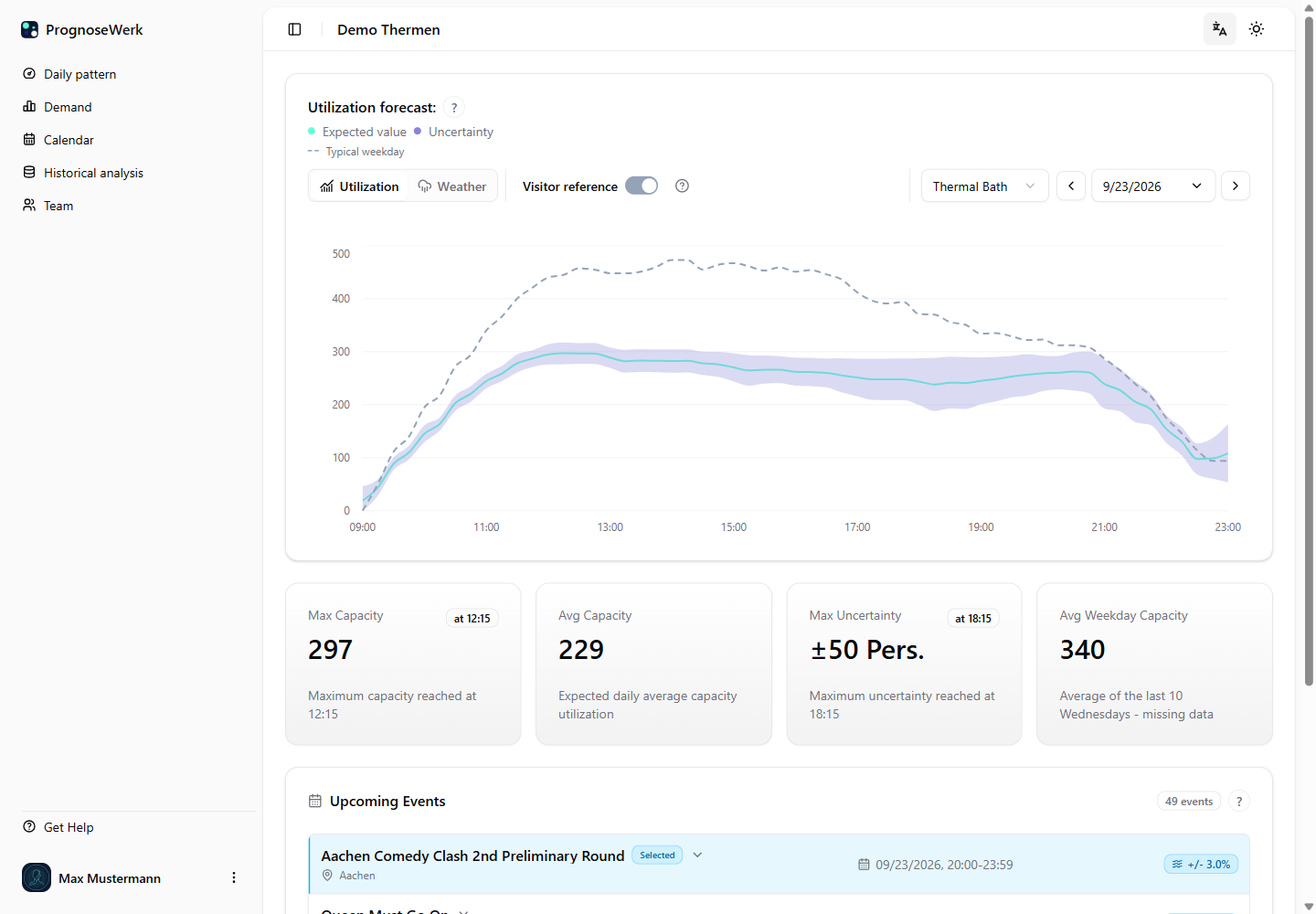
The forecasting core uses tree-based models and ensembles. Current development also compares ensemble-based intervals, quantile models, and residual-based calibration on held-out data. A central question is whether an interval captures the variation that matters to the person planning around it.
Research direction: Bayesian deep learning
I am interested in combining learned representations with Bayesian uncertainty estimates, including Bayesian last-layer models. This is an experimental direction alongside the current tree-based forecasting system. The practical question is whether uncertainty estimates remain useful when demand patterns change.
Measuring what a forecast knows
We examine forecast errors, interval coverage, and interval width across different lead times. Good uncertainty estimates should help a person judge how much to rely on a prediction and how much flexibility to leave in their plans.
My contribution
As a co-founder with Lennart Fanter, I work across machine learning, the application, customer conversations, and product development. This has taught me to start with the decisions a customer needs to make and work back to what the model should provide.